

Control growth instead of reacting to it.
Securing additional investment, a board deadline, or a missed revenue target triggers the instinct to move faster, hire a CMO, or fund more demand generation. While viable, none of those reactions prevent weak pipeline, revenue quality issues, rising acquisition costs, and retention risk from surfacing.
PragMattie works with founder-led B2B companies to identify the underlying gaps behind those resurfacing problems, so investment works harder. When leadership chooses one primary way to grow, go-to-market (GTM) priorities, data, workflows, reporting, and investment decisions are connected, and the business can control growth.
THE GROWTH PROBLEM
Four Warning Signs. Four Revenue Problems. Four Gaps.
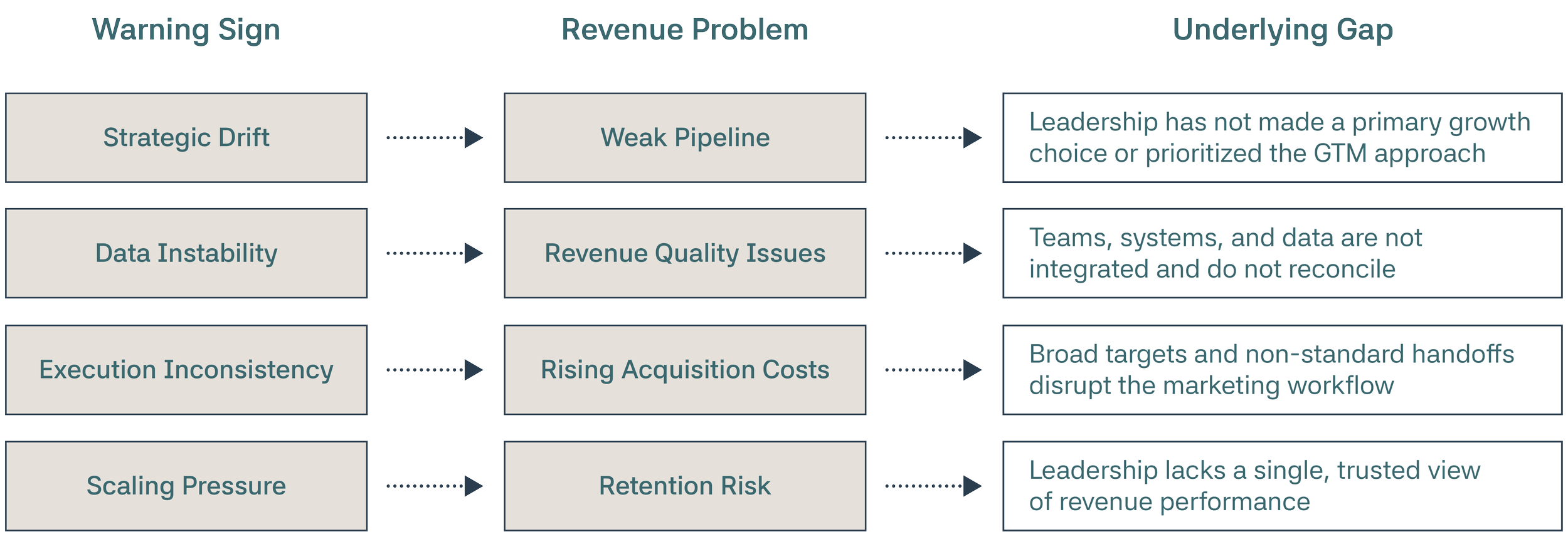
The PragMattie 4-4-4 Pattern connects four Warning Signs to four revenue problems and the underlying gaps behind them. Strategic Drift weakens pipeline when commercial priorities no longer reflect market conditions. Data Instability creates revenue quality issues when teams, systems, and data are not integrated and reconciled. Execution Inconsistency raises acquisition costs when competing priorities and non-standard handoffs disrupt the marketing workflow. Scaling Pressure obscures retention risk when leadership lacks a single, trusted view of revenue performance. When those gaps remain unresolved, additional growth pressure can contribute to scaling risk, efficiency drag, and slowdown.
When warning signs are ignored, the cost of growth rises
SCALING RISK
20-40%
higher risk of failure when startups scale within the first 12 months
Source: Harvard Business Review, 2024
EFFICIENCY DRAG
14%
higher sales and marketing expense to acquire $1 of new customer ARR
SLOWDOWN
26%
median growth rate, as top-quartile growth slowed from 60% to 50%
THE PRAGMATTIE SEQUENCE
The 4-Stage Readiness Sequence
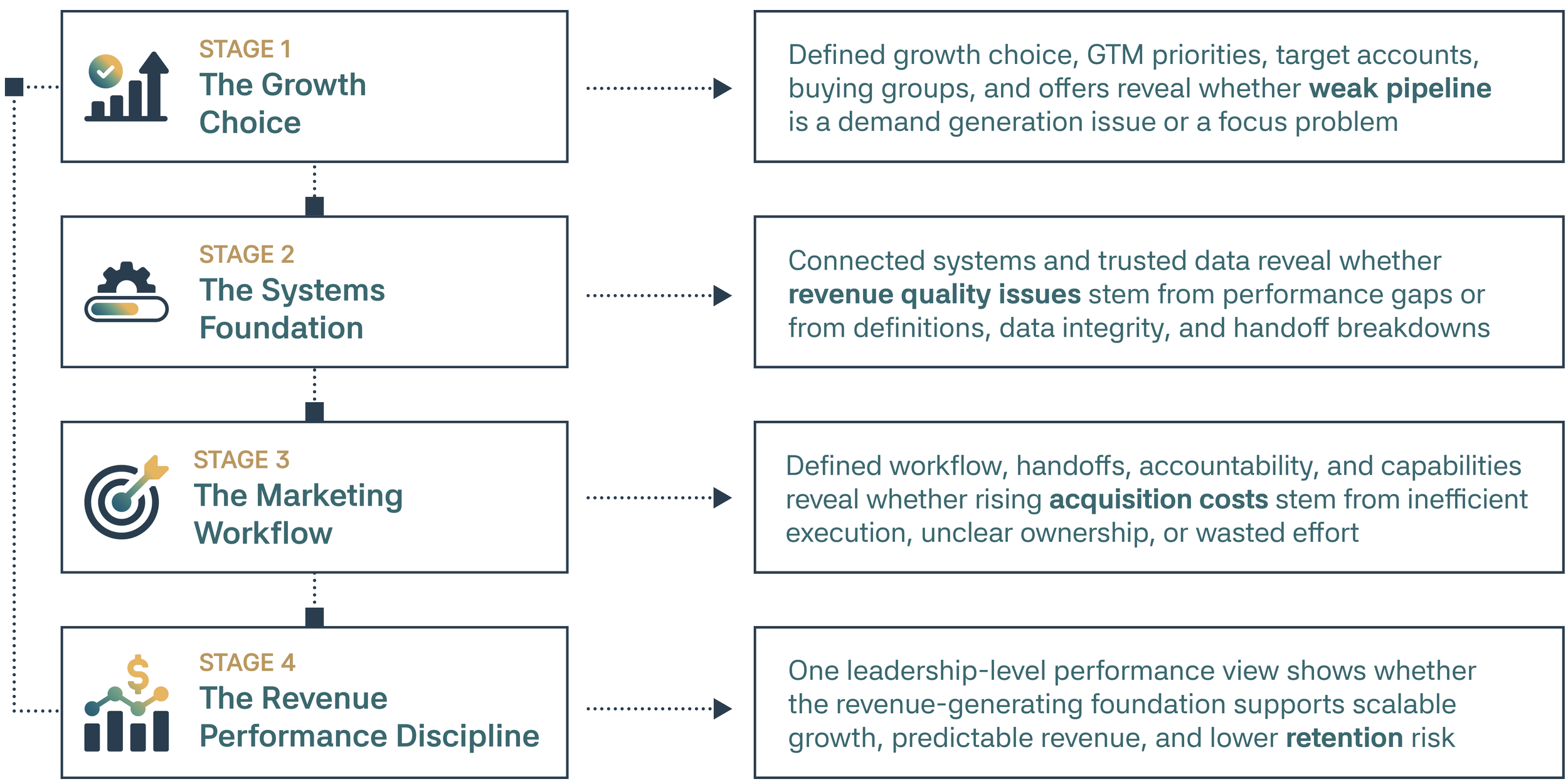
PragMattie runs the sequence with leadership to identify where investment is not ready to return more efficient ARR growth, stronger revenue quality, and a stronger next funding story. Each stage depends on closing the previous underlying gap. Skip a step, and revenue performance stays opinion, not fact, undermining the credibility of every number leadership brings to investors, while one or more of the same four problems remain unresolved.

STAGE 1
The Growth Choice
Leadership commits to a primary growth choice. These are distinct, not interchangeable, so only one can lead. That choice determines what leadership funds first, sets the GTM priorities, and defines what execution requires.

STAGE 2
The Systems Foundation
Core systems, supporting data, and integrations are assessed against that choice to determine whether execution requirements can be supported.

STAGE 3
The Marketing Workflow
Turns execution requirements into accountable work across planning, design, activation, measurement, and refinement. Roles, handoffs, capabilities, and measurement logic are defined before GTM activity increases.

STAGE 4
The Revenue Performance Discipline
Establishes whether reliable measurement is possible and reporting is factual, then separates material growth, efficiency, and risk signals from execution noise.
Stop guessing which gap to close first
The Closed Loop uses Stage 4's visibility to identify which revenue problems remain and which stage needs attention. Closing those underlying gaps now costs less than closing them after they compound.
WHO THIS BENEFITS
When problems are still addressable
These are the B2B companies most exposed to growth pressure before efficiency drag is obvious in the numbers. Market potential is established, but the revenue-generating foundation still depends on founder involvement, lean teams, and competing priorities.
When readiness is addressed before investment, growth scales from a stable foundation. When readiness is deferred, complexity compounds faster than revenue, and investment gets misallocated across people, programs, process, and technology.

Founder-Owned Revenue
Commercial decisions, customer context, and strategic tradeoffs still route through the founder.

Pre-Series B Funding Stage
Preparing to raise, recently funded, or under pressure to prove revenue performance discipline before exit.

Lean In-House Marketing Team
More generalists than specialists, often supplemented by external partners and dependent on tribal knowledge.
ABOUT

Who. Why. What’s next.
Barbie Mattie spent a decade at SiriusDecisions and Forrester Research, working directly with hundreds of B2B CMOs and marketing leaders. Across company size, industry, and investment stage, the same pattern kept resurfacing. Sales and marketing interpreted the go-to-market approach differently. Point solutions were adopted based on what technology was trending. Pipeline did not translate into predictable revenue. Execution activity could not be tied to business performance. Again and again, the root cause pointed back to the same issue: unresolved gaps in the foundation were surfacing under pressure.
Before SiriusDecisions and Forrester, Barbie spent 13 years at Advanced Micro Devices (AMD), one of the most complex go-to-market environments in the semiconductor industry. At the time, AMD operated as a B2B2B2C ingredient brand in a semiconductor market largely defined by two dominant players. That practitioner experience made one thing clear: execution efficiency gets harder to maintain as scale adds complexity. Every layer of scale introduces complexity that becomes far more expensive to untangle.
The same pattern became clear from both sides, whether advising executives from the outside or operating within a large, complex enterprise. PragMattie exists to help founder-led B2B leadership identify where the revenue-generating foundation is not ready, which underlying gaps sit behind the problems forming, and what must close before the next major investment is made.
“What I valued most working with Barbie was her ability to cut through noise and tell us what mattered. That clarity is rare, and it is the reason the strategy held up when we put it into practice.”
— Justin Proulx, AMD Client BU, Head of OEM Consumer and Commercial Channel GTM, AMD
“Barbie helps leaders at founder-led companies see where execution is getting ahead of the foundation required to support it. She identifies the underlying gap before more time, money, and resources are committed.”
— Jennifer Rouse, VP of Marketing, Autonomize AI
“As an angel investor, I value PragMattie's practical approach to identifying obstacles to growth before they become costly. This approach strengthens GTM execution and increases investor confidence.”
— Joseph Lui, Angel Investor
“Barbie has a rare ability to simplify complex decision-making, connecting strategy, messaging, priorities, and operational realities.”
— Rachelle McLure, Founder, ArdentLights
FAQs
Frequently Asked Questions
-
PragMattie delivers three core outputs: a Growth Choice Blueprint, a 4-Stage Readiness Assessment, and a Sequenced Gap Closure Plan.
The Growth Choice Blueprint defines the primary growth choice and the commercial inventory required to support it, including priority audiences, offers, segments, buying groups, market triggers, GTM approach, and execution requirements.
The 4-Stage Readiness Assessment shows whether the revenue-generating foundation can support the selected growth choice across systems and data, marketing workflow, and revenue performance discipline.
The Sequenced Gap Closure Plan defines what must close, and in what order, before more budget, hiring, tools, or execution capacity are added.
Leadership leaves with a practical view of where the revenue-generating foundation can support the growth choice, where gaps remain, and what must close before the next major growth investment is made.
-
PragMattie is not an open-ended advisory role or a fractional marketing leader. It is a defined diagnostic and planning engagement designed to help founders identify where the revenue-generating foundation is not ready before they assign execution ownership, make growth-critical hires, bring in outside execution support, or commit more capital to growth. The goal is to identify unresolved gaps before more money, people, tools, or expectations are put against the selected growth choice.
Consultants often advise on strategy or execution. Fractional CMOs often lead marketing activity. PragMattie works before those decisions are fully funded or assigned. The work assesses the revenue-generating foundation, identifies gaps across the four stages, and creates a Sequenced Gap Closure Plan leadership can use to decide what to fix, fund, hire, or delegate first.
PragMattie may need access to core revenue systems to evaluate the current state, but does not stay embedded to run execution. When execution support is needed, PragMattie can connect founders to trusted partners. PragMattie creates the plan; leadership decides how to execute it.
-
The completed work is designed to guide decisions, not sit in a folder. Leadership leaves with three tools designed to work together as one decision system.
The Growth Choice Blueprint defines the commercial opportunity, the selected growth choice, and the first GTM focus. The 4-Stage Readiness Assessment shows where the revenue-generating foundation can support the selected growth choice, where gaps remain, and which gaps create risk. The Sequenced Gap Closure Plan defines what must close, and in what order, before more capital, hiring, tools, or AI are added.
PragMattie does not create dependency. The goal is a shared decision discipline leadership can keep using for people, programs, processes, and technology, without defaulting to legacy plans, disconnected assumptions, or last year's priorities.
When execution support is needed, PragMattie can connect leadership to trusted partners. PragMattie creates the plan; leadership decides how to execute it.
-
Yes. Stage 1 can be scoped as a standalone engagement when leadership needs to select the primary growth choice and prioritize the GTM approach before moving into a full 4-Stage Readiness Assessment.
Stage 1 defines the primary growth choice, organizes the commercial inventory, and identifies the GTM priorities leadership should focus on first.
Based on the agreed scope, the output may include a Growth Choice Blueprint, focused GTM pilot plan, target audience profile, account criteria, messaging priorities, sales enablement priorities, measurement logic, budget assumptions, role requirements, or closeout and transition guidance.
The value is not only the plan. Stage 1 gives Sales, Marketing, Operations, and leadership a practical way to approach future programs with more focus. It clarifies who leadership is targeting, why that audience is more likely to act now, which message should take priority, what Sales needs to support follow-up, and what the business should measure from first touch through revenue impact.
Stage 1 also identifies the execution requirements and performance signals the selected growth choice depends on. It can surface whether leadership has the data, systems, workflow, ownership, and revenue visibility needed to support the chosen growth choice. If material gaps surface, PragMattie can identify which later stage needs deeper assessment.
Stage 1 does not replace the full 4-Stage Readiness Sequence. It gives leadership a focused starting point before the next major growth investment is made.
-
PragMattie is built first for founder-led B2B companies at the Pre-Series B stage, when capital, hiring, tools, expansion, and execution pressure are increasing.
The 4-Stage Readiness Sequence can also support investors, portfolio companies, business units, product lines, or specific growth initiatives when the scope is clearly bounded. In those cases, the work starts with a defined growth decision, market, segment, product, or initiative rather than the full business.
That focus matters. A bounded scope gives leadership a practical way to assess the revenue-generating foundation, identify gaps, and determine what must close before more budget, hiring, tools, or execution capacity are added.
For investors or larger organizations, this keeps the work tied to a specific growth decision instead of turning into a broad transformation effort.
-
For B2B founders at Pre-Series B, the pressure is often to move faster, hire a CMO, or fund more demand generation. None of those closes an underlying gap in the revenue-generating foundation, so the same revenue problems keep resurfacing and become more expensive to untangle.
If the revenue-generating foundation is not stable, AI can amplify weak signals, automate unclear workflows, and make existing gaps harder to diagnose.
PragMattie helps leadership identify where AI can support the selected growth choice and where it may add complexity before the revenue-generating foundation is stable.